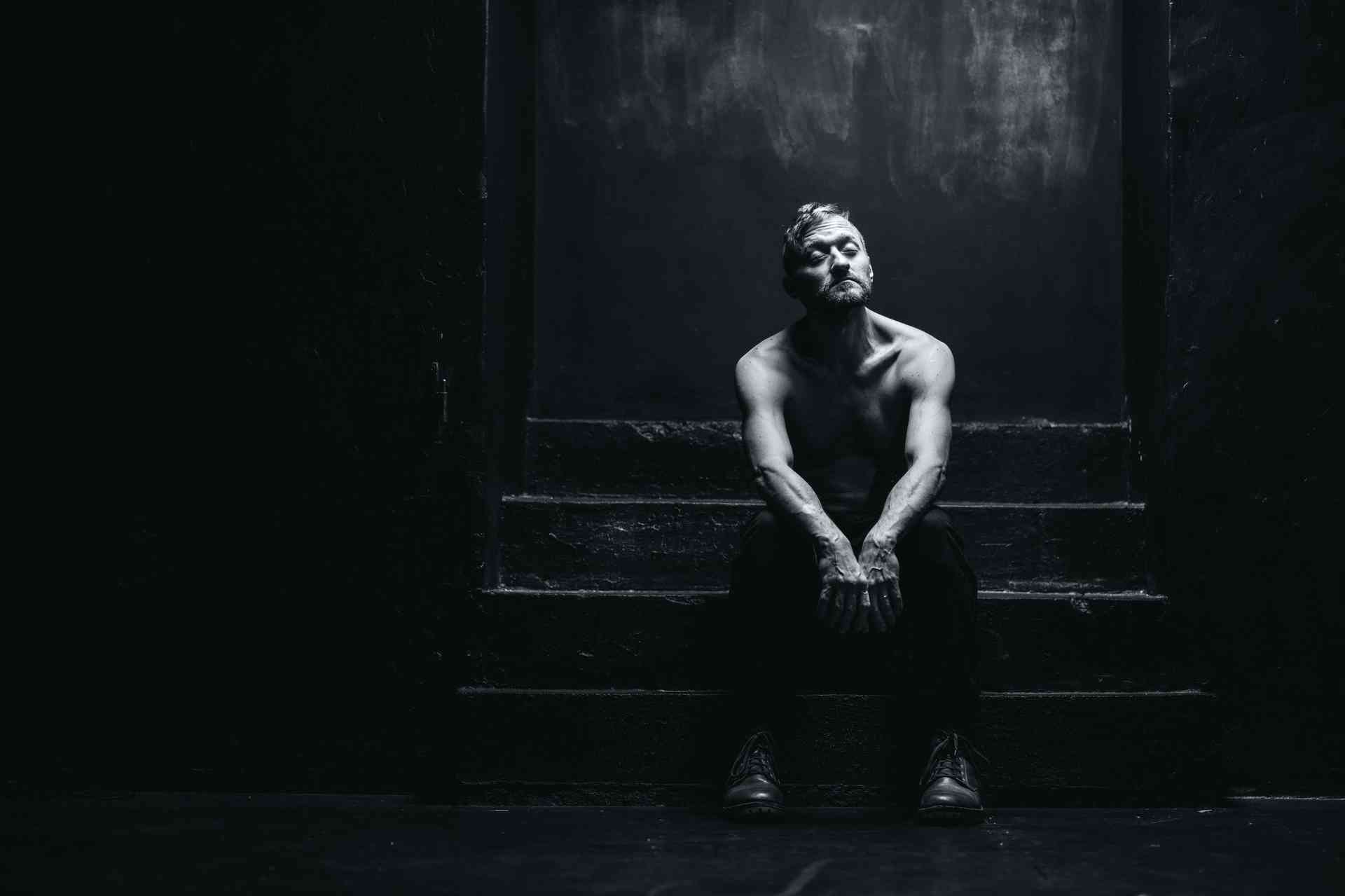
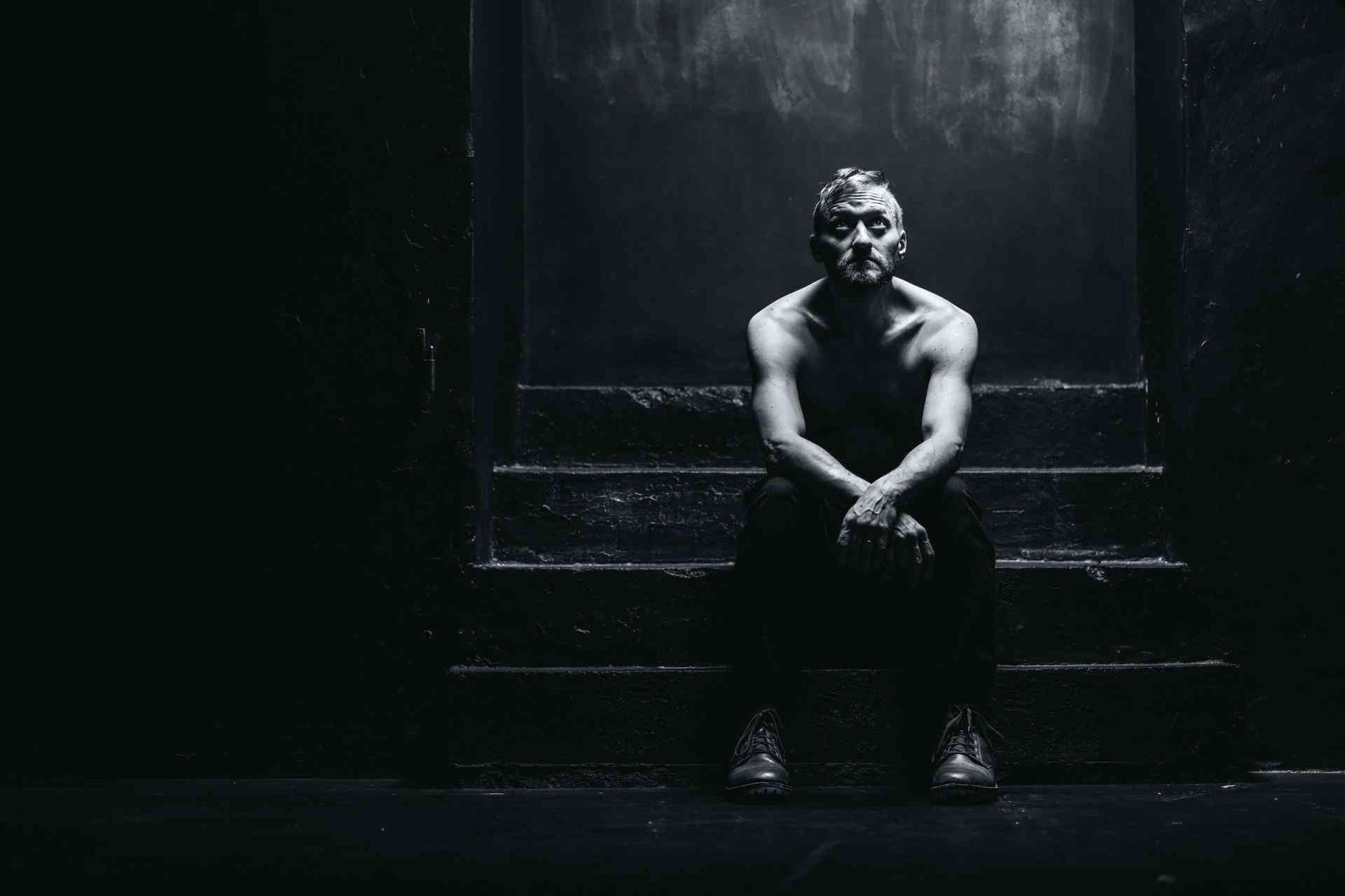
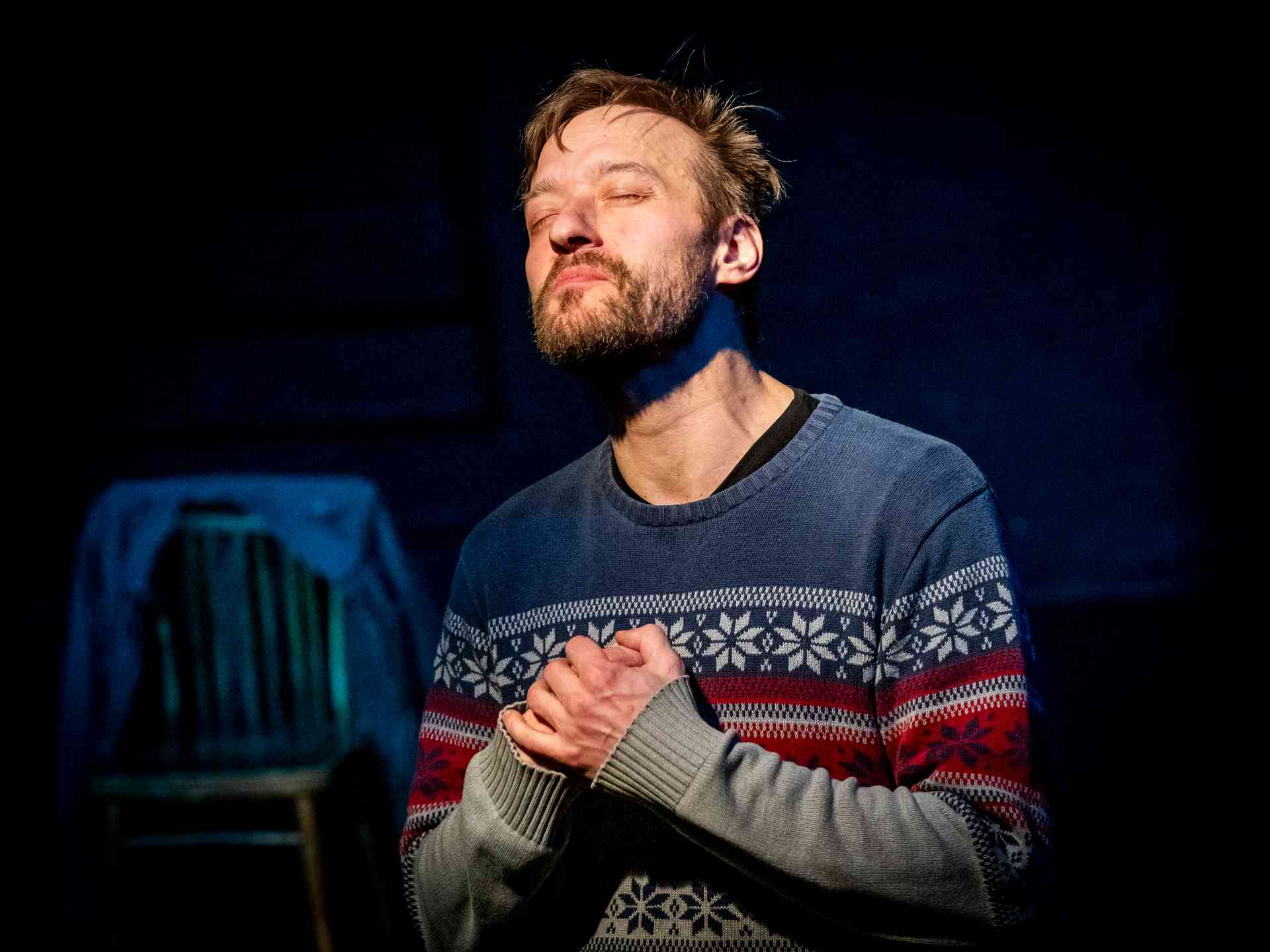
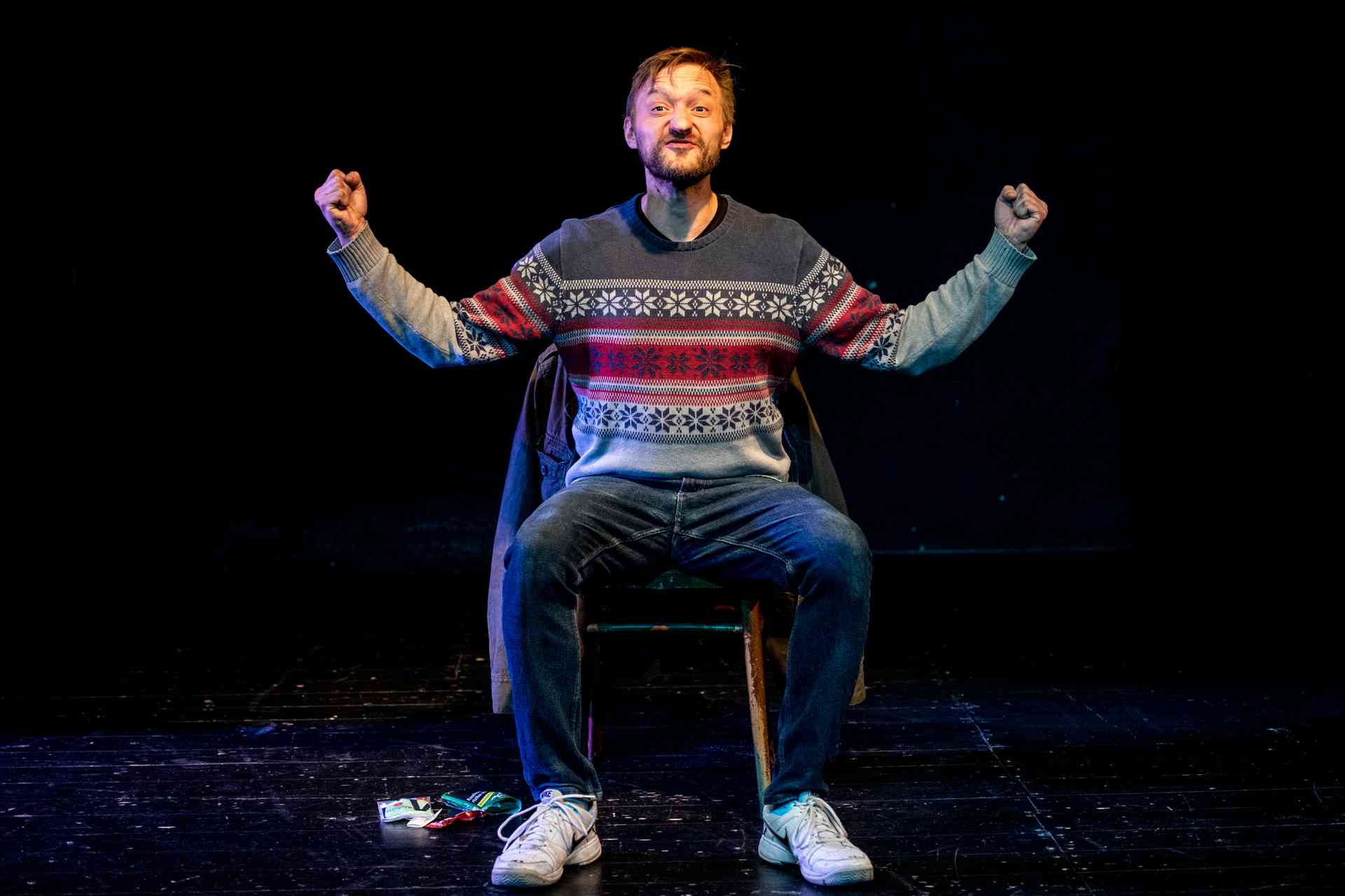
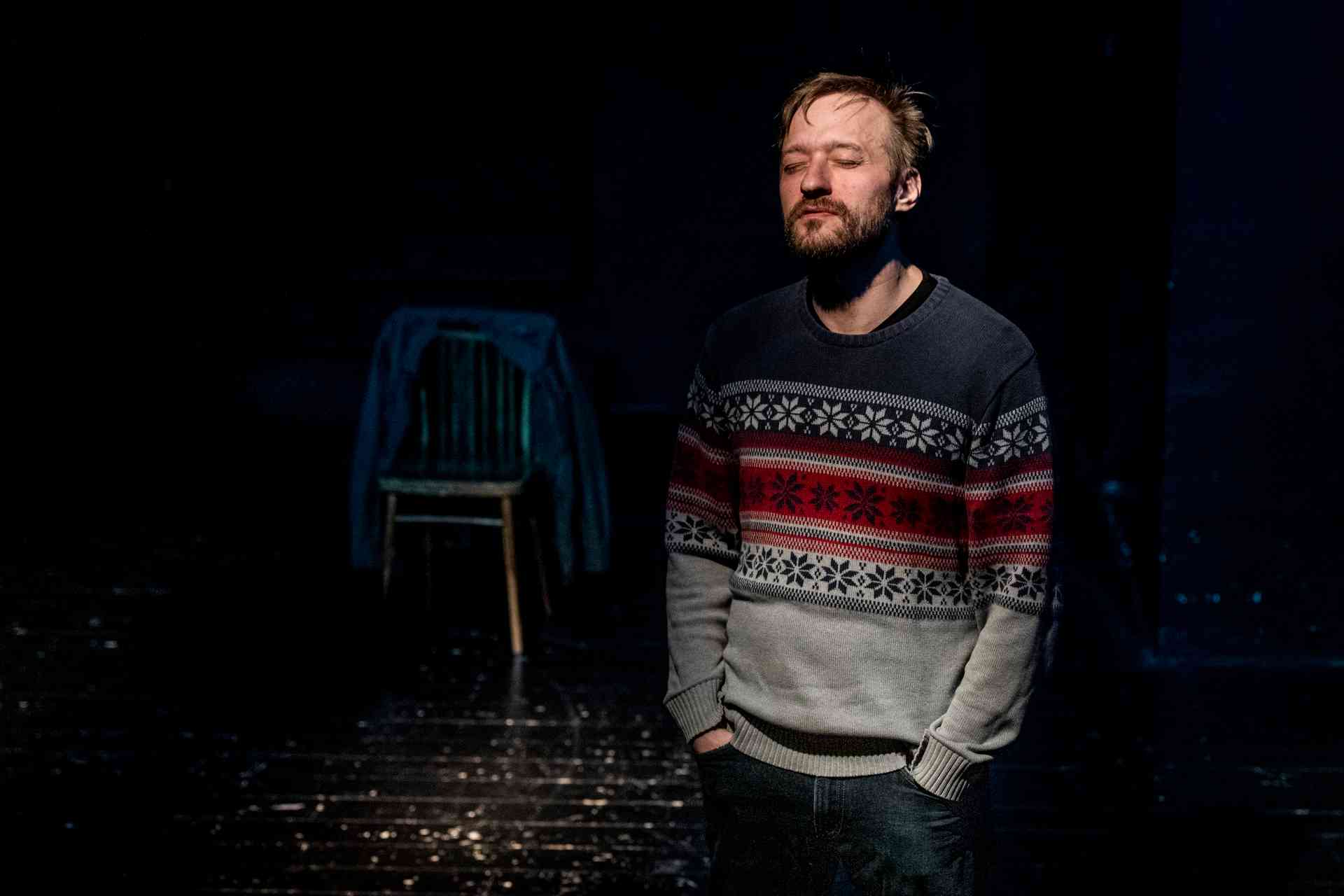
THE METH MAKER Roman is from Havířov. Roman wanted to take drugs. Roman smoked, drank, sniffed and injected them. Roman loved Dita. Roman served time. In prisons and detox centres. Roman cooked drugs, methamphetamine above all. Roman made the purest meth of all. Roman got out of it; Roman survived. Roman is alive, and his story was written down in the book Perníková chaloupka (Meth House) by Petr Motýl. And now it’s a piece of theatre. Roman is played by Panzi. Panzi is from Havířov. Petr Panzenberger won a Thálie Award for the role of Roman.
Petr Panzenberger is a born talent. We’ve long been used to seeing him on a big stage, and there’s nothing surprising in the range that lets him swing from a bloodthirsty Richard III to a delightful Truffaldino. But what happens when you cast “Panzi” as a former addict from Havířov telling his own life story? What happens is that you believe every word. He faces the audience with complete assurance and, looking them in the eye, tells the story of a man who is, after all, a stranger to him – and not once does he falter as he carries us through every key turn of this (to me) unimaginable life.
EVELÍNA VANĚK SÍČOVÁ, Ostravan.cz
Panzenberger’s performance is the heart of the production, describing a hard life of drugs and trouble with the police entirely without sentimentality. He knows exactly how to pace the funny stories from the drug underworld of the Ostrava region and beyond – first in the “normalisation” period of the 1970s, then in the changed world after the Velvet Revolution. But the laughter often dies on your lips when he turns to the toll that years of chemical cocktails took on Roman’s friends, and to the number of young people’s funerals he had to attend.
LUKÁŠ DUBSKÝ, Nadivadlo.cz
One of the real strengths of The Meth Maker is its refusal to moralise. It simply lets the audience look into the life of one man who, somewhere along the way, ran into drugs that scarred him for a time almost beyond repair.
JIŘÍ LANDA, Divadelní noviny
The stage belongs to Panzenberger’s playfulness, ease and truthfulness; there isn’t a trace of glib moralising. One (extra)ordinary human life, here and now. Humanism at its most powerful. Period.
PETR KLARIN KLÁR, Divadelni.net
VOJTĚCH ŠTĚPÁNEK (1984) trained as an actor at the Prague State Conservatoire under Hana Maciuchová and Jan Novotný. He began his professional career at the Strašnice Theatre, where from 2005 he worked as an actor and later as resident director and a member of its management. In 2011 the company moved to central Prague, winning the tender to run the Divadlo Komedie, where Štěpánek became resident director and, from 2013, artistic director too. Under him the theatre built its reputation as a Centre for Eastern European Drama, staging plays from across Eastern Europe – classics alongside wholly new or still--undiscovered writers. In 2018 he became head of drama at the National Moravian-Silesian Theatre. As a director his credits include The Talking Cure, A Year in a Village, Diplomacy, Exit the King, Leaving, Marie Antoinette, The Truth, Nightscape and many more. His work is driven on the one hand by a commitment to authenticity and close work with the ensemble, and on the other by an appetite for opening up urgent social questions. His productions tend to probe and unsettle received traditions, turning over moral dilemmas and human relationships, and treating theatre as a space for dialogue and deeper understanding.
STUDIO G An independent drama company in Ostrava, founded in 2019. It makes its own original work as well as staging contemporary and classic texts, usually for small casts. Its dramaturgy looks for provocative, contemporary, living subjects with which to reach younger audiences in particular. Studio G grew out of a shared urge to make theatre across Ostrava’s various stages and to work with colleagues beyond the day job at their home theatres. Its productions bring together actors from every Ostrava theatre as well as drama students, above all from the Janáček Conservatory in Ostrava – and it is exactly this meeting of seasoned artists with students and emerging professionals that lies at the company’s core. Directors who have worked with Studio G include Pavel Gejguš, Janusz Klimsza, Tereza Agelová, Peter Gábor, Vojtěch Štěpánek, Marek David, David Vyhnánek, Josef Doležal and others.